Arduino Diecimila specs & datasheets
The 2007 Arduino whose name means “ten thousand” in Italian, marking the boards sold: an ATmega168 with an FTDI USB chip and auto-reset.
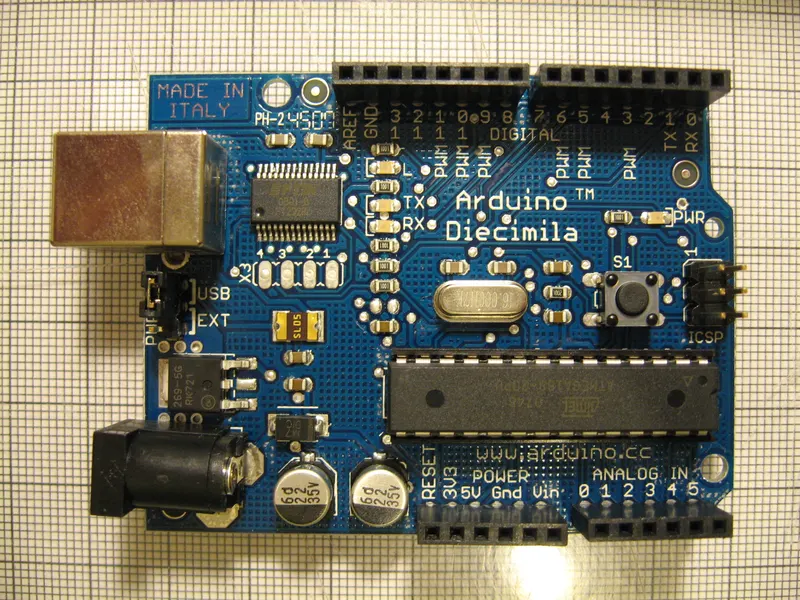

- Chip / SoC
- Microchip (Atmel) ATmega168
- CPU
- 8-bit AVR
- Clock
- 16 MHz
- RAM
- 1 KB SRAM
- Flash
- 16 KB (2 KB used by the bootloader)
- I/O voltage
- 5 V
- Released
- 2007
- Status
- Retired
Draft entry: these specs were compiled from the linked sources and are waiting for a second check. Spotted a mistake? Use the form at the end of the page.
Specifications
- Chip / SoC
- Microchip (Atmel) ATmega168[1]
- CPU
- 8-bit AVR[2]
- Clock
- 16 MHz[1]
- RAM
- 1 KB SRAM[2]
- Flash
- 16 KB (2 KB used by the bootloader)[1]
- EEPROM
- 512 bytes[2]
- GPIO
- 14 digital I/O (6 PWM)[1]
- Analog
- 6 analog inputs (10-bit)[1]
- I/O voltage
- 5 V[1]
- Input voltage
- 7–12 V recommended via barrel jack, or 5 V via USB[1]
- USB
- USB-B via FTDI FT232RL[1]
- Upload limits
- 14 KB flash, 1 KB RAM[4]
Upload limits are what a sketch or firmware may use after the bootloader, as the build tools enforce them, not the chip’s full memory.
Can I still use it?
- Arduino framework
- Supported[1]Supported by the AVR core as “Arduino Duemilanove or Diecimila”.
As published by each project, checked weekly. A platform not listed has no published information here, which is not the same as no support.
Datasheets and documents
Gotchas
What changed
Next came the Arduino Duemilanove
| Spec | Arduino Diecimila | Arduino Duemilanove |
|---|---|---|
| Chip / SoC | Microchip (Atmel) ATmega168 | Microchip (Atmel) ATmega328 (early boards: ATmega168) |
| RAM | 1 KB SRAM | 2 KB SRAM (1 KB on ATmega168 boards) |
| Flash | 16 KB (2 KB used by the bootloader) | 32 KB (2 KB used by the bootloader) |
| EEPROM | 512 bytes | 1 KB |
History and use today
History
The Diecimila was the first Arduino with an auto-reset circuit, so sketches uploaded without pressing the reset button, which set the workflow every later Arduino followed.[3]
Still useful for
A collector's board now; any Uno-compatible board runs the same sketches with twice the memory.
Sources
Spotted a mistake?
Every report is read by a person and checked against a source before anything changes. Please link one if you have it.