Arduino Due specs & datasheets
The first 32-bit Arduino: an 84 MHz Arm Cortex-M3 in the Mega layout, with 512 KB of flash, two DACs and 3.3 V I/O.
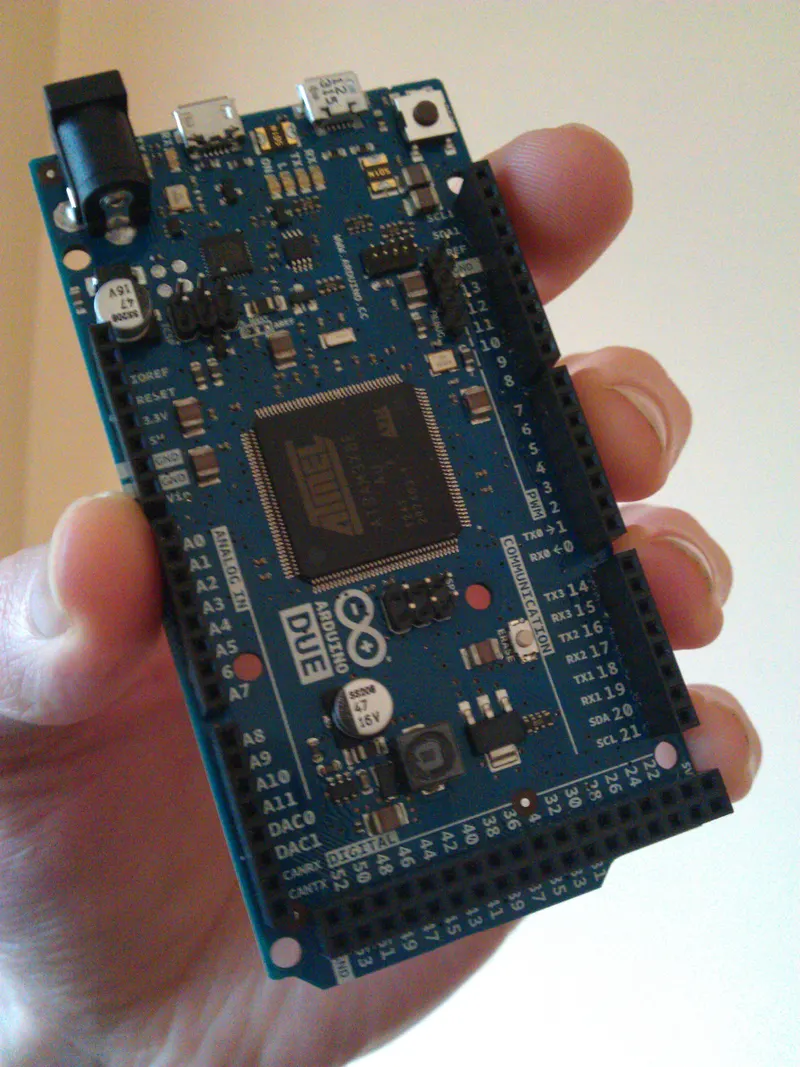

- Chip / SoC
- Microchip (Atmel) SAM3X8E
- CPU
- Arm Cortex-M3
- Clock
- 84 MHz
- RAM
- 96 KB SRAM
- Flash
- 512 KB
- I/O voltage
- 3.3 V
- Released
- October 2012
- Status
- In production
Draft entry: these specs were compiled from the linked sources and are waiting for a second check. Spotted a mistake? Use the form at the end of the page.
Specifications
- Chip / SoC
- Microchip (Atmel) SAM3X8E[1]
- CPU
- Arm Cortex-M3[1]
- Clock
- 84 MHz[1]
- RAM
- 96 KB SRAM[1]
- Flash
- 512 KB[2]
- GPIO
- 54 digital I/O (12 PWM); 4 UARTs; 2 CAN[1]
- Analog
- 12 analog inputs; 2 DAC outputs[1]
- I/O voltage
- 3.3 V[1]
- USB
- Micro-USB programming port and native USB OTG port[1]
- Upload limits
- 512 KB flash, 96 KB RAM[4]
Upload limits are what a sketch or firmware may use after the bootloader, as the build tools enforce them, not the chip’s full memory.
Can I still use it?
- Arduino framework
- Supported[1]Official Arduino core.
- Zephyr RTOS
- Supported[6]
As published by each project, checked weekly. A platform not listed has no published information here, which is not the same as no support.
Datasheets and documents
Gotchas
- 3.3 V I/O on a Mega layout. The Due looks like a Mega but its pins are 3.3 V and not 5 V tolerant; 5 V shields can destroy it.[1]
History and use today
History
Announced in 2012, the Due was Arduino's first Arm board, bringing 32-bit performance, DACs and CAN to the Mega form factor.[1]
Still useful for
Still used for audio and CAN projects; newer boards like the Giga R1 and Teensy 4 are faster.
Sources
Spotted a mistake?
Every report is read by a person and checked against a source before anything changes. Please link one if you have it.