BeagleBone Black specs & datasheets
The open-hardware Linux board with 92 header pins and two real-time PRU cores, on a TI Sitara AM3358 at 1 GHz.
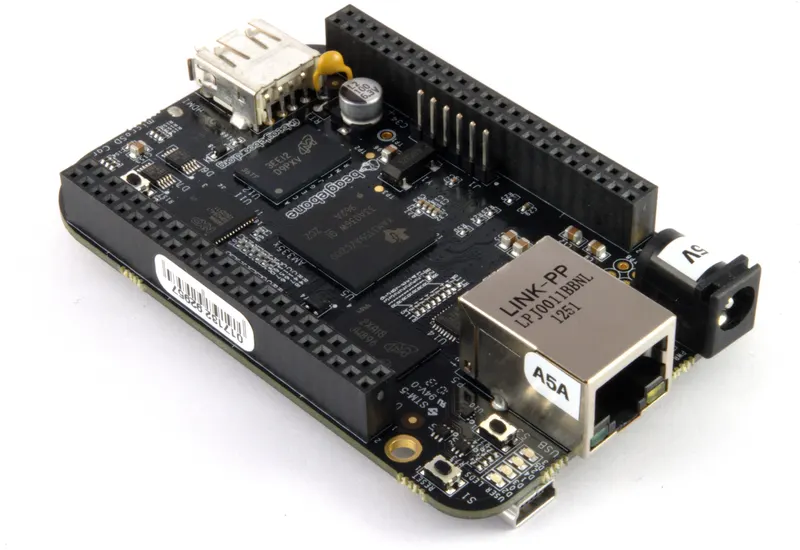
.jpg)
- Chip / SoC
- Texas Instruments AM3358
- CPU
- Arm Cortex-A8, plus 2 × PRU 32-bit real-time units
- Clock
- 1 GHz
- RAM
- 512 MB DDR3
- Storage
- 4 GB eMMC (2 GB before revision C) and microSD
- I/O voltage
- 3.3 V; analog inputs 1.8 V max
- Released
- April 2013
- Status
- In production
Draft entry: these specs were compiled from the linked sources and are waiting for a second check. Spotted a mistake? Use the form at the end of the page.
Specifications
- Chip / SoC
- Texas Instruments AM3358[1]
- CPU
- Arm Cortex-A8, plus 2 × PRU 32-bit real-time units[1]
- Clock
- 1 GHz[1]
- RAM
- 512 MB DDR3[1]
- Storage
- 4 GB eMMC (2 GB before revision C) and microSD[1]
- GPU
- PowerVR SGX530[2]
- GPIO
- 2 × 46-pin headers (P8, P9)[1]
- I/O voltage
- 3.3 V; analog inputs 1.8 V max[1]
- Input voltage
- 5 V via barrel jack or USB[1]
- Ethernet
- 10/100[1]
- USB
- 1 × USB host, 1 × mini-USB client[1]
- Video
- Micro-HDMI[1]
Datasheets and documents
Gotchas
Revisions
- Revision C
- 2014: eMMC grew from 2 GB to 4 GB; Debian replaced Ångström as the shipped OS.[3]
History and use today
History
Launched in April 2013 at $45, the BeagleBone Black was the open-hardware answer to the Raspberry Pi, aimed at engineers rather than classrooms.[3]
Still useful for
Its PRUs still make it the board of choice for deterministic I/O under Linux, such as Machinekit CNC control; for raw speed, newer Beagle boards or a Pi are faster.
Sources
Spotted a mistake?
Every report is read by a person and checked against a source before anything changes. Please link one if you have it.