NodeMCU DevKit 1.0 (ESP8266) specs & datasheets
The open-hardware ESP8266 board that made Wi-Fi projects cheap: an ESP-12E module with USB-serial and breadboard headers.
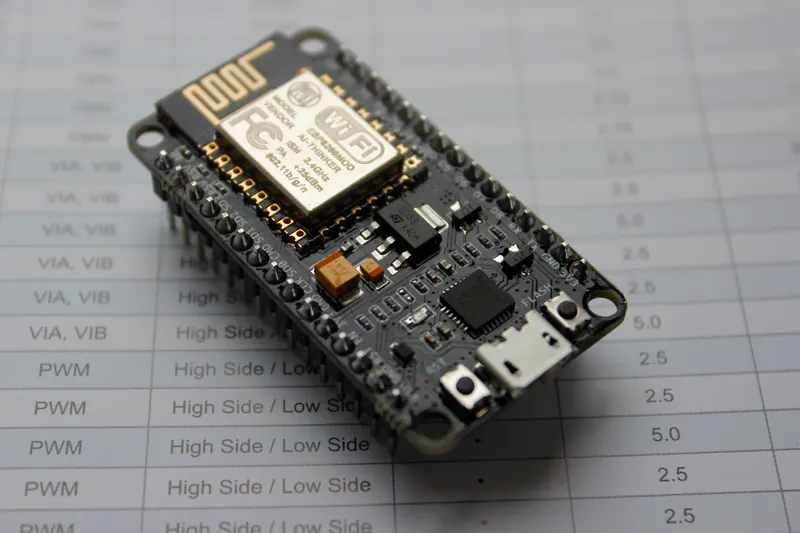

- Chip / SoC
- Espressif ESP8266EX in an ESP-12E module
- CPU
- Tensilica L106, 32-bit
- Clock
- Up to 160 MHz
- RAM
- About 50 KB of heap and data RAM free for applications (Wi-Fi station connected)
- Flash
- 4 MB
- Wireless
- 2.4 GHz 802.11 b/g/n Wi-Fi
- I/O voltage
- 3.3 V
- Released
- 2015
- Status
- In production
Specs checked against the cited sources on 1 October 2026 (AI-assisted source check). Spotted a mistake? Use the form at the end of the page.
Specifications
- Chip / SoC
- Espressif ESP8266EX in an ESP-12E module[1]
- CPU
- Tensilica L106, 32-bit[2]
- Clock
- Up to 160 MHz[2]
- RAM
- About 50 KB of heap and data RAM free for applications (Wi-Fi station connected)[2]
- Flash
- 4 MB[1]
- Analog
- 1 analog input (10-bit)[2]0–1 V at the chip; the board's 220 kΩ/100 kΩ divider gives about 0–3.2 V on A0 (schematic in the NodeMCU repository).
- I/O voltage
- 3.3 V[1]
- Wireless
- 2.4 GHz 802.11 b/g/n Wi-Fi[2]
- USB
- Micro-USB via a Silicon Labs CP2102 USB-to-UART bridge[1]
- Upload limits
- 4 MB flash, 80 KB RAM[5]
Upload limits are what a sketch or firmware may use after the bootloader, as the build tools enforce them, not the chip’s full memory.
Can I still use it?
- Arduino framework
- Community support[3]ESP8266 core for Arduino, maintained by the community.
- MicroPython
- Supported[7]
As published by each project, checked weekly. A platform not listed has no published information here, which is not the same as no support.
Datasheets and documents
Gotchas
History and use today
History
NodeMCU started in October 2014 as Lua firmware for the ESP8266, and its open-hardware DevKit made the chip easy to use on a breadboard.[4]
Still useful for
Still a cheap way to put a sensor on Wi-Fi. Espressif lists the ESP8266EX as not recommended for new designs, so new projects usually start on an ESP32-C3.
Sources
Spotted a mistake?
Every report is read by a person and checked against a source before anything changes. Please link one if you have it.