Arduino Uno (R1–R3) specs, pinout & datasheets
The reference Arduino since 2010: an ATmega328P at 16 MHz with 32 KB of flash, a USB-serial chip of its own and the header layout every shield follows.
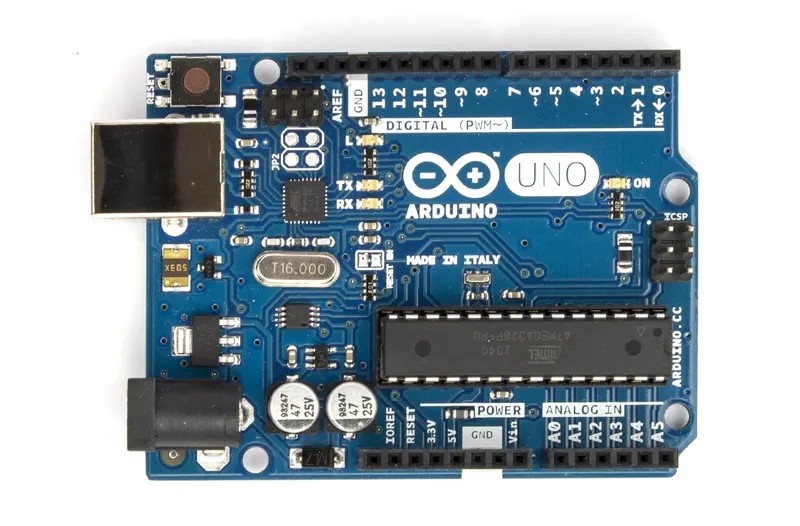

- Chip / SoC
- Microchip ATmega328P
- CPU
- 8-bit AVR
- Clock
- 16 MHz
- RAM
- 2 KB SRAM
- Flash
- 32 KB (0.5 KB used by the bootloader)
- I/O voltage
- 5 V
- Released
- September 2010
- Status
- In production
Specs checked against the cited sources on 1 October 2026 (AI-assisted source check). Spotted a mistake? Use the form at the end of the page.
Specifications
- Chip / SoC
- Microchip ATmega328P[1]
- CPU
- 8-bit AVR[4]
- Clock
- 16 MHz[1]
- RAM
- 2 KB SRAM[4]
- Flash
- 32 KB (0.5 KB used by the bootloader)[8]
- EEPROM
- 1 KB[1]
- GPIO
- 14 digital I/O (6 PWM)[1]
- Analog
- 6 analog inputs (10-bit)[4]
- I/O voltage
- 5 V[2]
- Input voltage
- 7–12 V recommended via barrel jack or VIN; 5 V via USB[1]
- USB
- USB-B via an ATmega16U2 (R3) or ATmega8U2 (R1, R2)[5]
- Dimensions
- 68.6 × 53.4 mm, 25 g[1]
- Upload limits
- 31.5 KB flash, 2 KB RAM[12]
Upload limits are what a sketch or firmware may use after the bootloader, as the build tools enforce them, not the chip’s full memory.
Can I still use it?
- Arduino framework
- Supported[1]Official Arduino core.
As published by each project, checked weekly. A platform not listed has no published information here, which is not the same as no support.
Datasheets and documents
Pinout
- Power
- Ground
- GPIO
- Special
- Not connected
Pin table (32 pins)
| Pin | Label | Kind | Functions |
|---|---|---|---|
| 1 | NC | Not connected | |
| 2 | IOREF | Power | I/O reference voltage |
| 3 | RESET | Special | Reset (active low) |
| 4 | 3.3V | Power | |
| 5 | 5V | Power | |
| 6 | GND | Ground | |
| 7 | GND | Ground | |
| 8 | VIN | Power | Input voltage |
| Pin | Label | Kind | Functions |
|---|---|---|---|
| 1 | A0 | GPIO | ADC |
| 2 | A1 | GPIO | ADC |
| 3 | A2 | GPIO | ADC |
| 4 | A3 | GPIO | ADC |
| 5 | A4 | GPIO | ADC, I2C SDA |
| 6 | A5 | GPIO | ADC, I2C SCL |
| Pin | Label | Kind | Functions |
|---|---|---|---|
| 1 | D0 | GPIO | UART RX |
| 2 | D1 | GPIO | UART TX |
| 3 | D2 | GPIO | INT0 |
| 4 | D3 | GPIO | PWM, INT1 |
| 5 | D4 | GPIO | |
| 6 | D5 | GPIO | PWM |
| 7 | D6 | GPIO | PWM |
| 8 | D7 | GPIO |
| Pin | Label | Kind | Functions |
|---|---|---|---|
| 1 | D8 | GPIO | |
| 2 | D9 | GPIO | PWM |
| 3 | D10 | GPIO | PWM, SPI SS |
| 4 | D11 | GPIO | PWM, SPI MOSI |
| 5 | D12 | GPIO | SPI MISO |
| 6 | D13 | GPIO | SPI SCK, LED |
| 7 | GND | Ground | |
| 8 | AREF | Special | Analog reference |
| 9 | SDA | GPIO | I2C SDA (same as A4) |
| 10 | SCL | GPIO | I2C SCL (same as A5) |
Gotchas
- 2 KB of RAM goes fast. String literals are copied into RAM unless they are kept in flash with PROGMEM or wrapped in F(); text-heavy sketches fill the 2 KB of SRAM long before the flash.[10]
- Pins 0 and 1 are the USB serial. D0 and D1 carry the serial link to the computer; anything connected to them can interfere with Serial output and cause failed uploads.[9]
- 5 V logic. I/O is 5 V. Sensors and modules that run at 3.3 V (most modern ones) need level shifting on their inputs.[1]
What changed
Since the Arduino Duemilanove
| Spec | Arduino Duemilanove | Arduino Uno (R1–R3) |
|---|---|---|
| Chip / SoC | Microchip (Atmel) ATmega328 (early boards: ATmega168) | Microchip ATmega328P |
| RAM | 2 KB SRAM (1 KB on ATmega168 boards) | 2 KB SRAM |
| Flash | 32 KB (2 KB used by the bootloader) | 32 KB (0.5 KB used by the bootloader) |
| Input voltage | 7–12 V recommended via barrel jack, or 5 V via USB | 7–12 V recommended via barrel jack or VIN; 5 V via USB |
| USB | USB-B via FTDI FT232RL | USB-B via an ATmega16U2 (R3) or ATmega8U2 (R1, R2) |
| Dimensions | — | 68.6 × 53.4 mm, 25 g |
Next came the Arduino Uno R4 Minima
| Spec | Arduino Uno (R1–R3) | Arduino Uno R4 Minima |
|---|---|---|
| Chip / SoC | Microchip ATmega328P | Renesas RA4M1 (R7FA4M1AB3CFM) |
| CPU | 8-bit AVR | Arm Cortex-M4F |
| Clock | 16 MHz | 48 MHz |
| RAM | 2 KB SRAM | 32 KB SRAM |
| Flash | 32 KB (0.5 KB used by the bootloader) | 256 KB |
| EEPROM | 1 KB | 8 KB data flash |
| GPIO | 14 digital I/O (6 PWM) | 14 digital I/O |
| Analog | 6 analog inputs (10-bit) | 6 analog inputs (up to 14-bit); 12-bit DAC on A0 |
| Input voltage | 7–12 V recommended via barrel jack or VIN; 5 V via USB | 6–24 V on VIN or the barrel jack; 5 V via USB-C |
| USB | USB-B via an ATmega16U2 (R3) or ATmega8U2 (R1, R2) | USB-C, native USB on the RA4M1 (HID capable) |
| Dimensions | 68.6 × 53.4 mm, 25 g | — |
| Launch price | — | US$20 |
Power and battery
Size and mechanical
- Board size
- 68.6 × 53.4 mm[1]
Revisions
- R1
- September 2010: ATmega8U2 as the USB-to-serial converter in place of the FTDI chip of earlier boards.[7]
- R2
- Added a resistor pulling the ATmega8U2's HWB line to ground, making it easier to put the USB chip into DFU mode.[6]
- R3
- The 1.0 pinout: SDA and SCL pins beside AREF, IOREF and a spare pin beside RESET; a stronger reset circuit; the ATmega16U2 replaces the 8U2.[6]
History and use today
History
Unveiled in September 2010, the Uno (Italian for “one”, named for the upcoming Arduino 1.0) replaced the FTDI chip with a programmable ATmega8U2. The R3 revision introduced the “1.0 pinout” (IOREF, and SDA/SCL beside AREF) that later Arduino boards and most clones follow.[5]
Still useful for
Still the board most tutorials, shields and classrooms assume. For new designs that need more memory or Wi-Fi, the Uno R4 keeps the layout.
Projects from the archive
Sources
- Arduino UNO R3, Arduino documentation
- Arduino UNO R3 datasheet (A000066)
- Arduino UNO R3 full pinout (A000066)
- ATmega328P product page, Microchip
- Arduino Uno, arduino.cc (archived 2013)
- An overview of different UNO boards, Arduino Help Center
- Dinner is ready (Uno and Mega 2560 launch), Arduino blog, 24 September 2010 (archived)
- Arduino AVR core board definitions (boards.txt), Arduino
- Serial, Arduino language reference
- PROGMEM, Arduino language reference
- Arduino UNO R3 schematics (A000066)
- PlatformIO board definition (uno)
Spotted a mistake?
Every report is read by a person and checked against a source before anything changes. Please link one if you have it.