Raspberry Pi 2 Model B specs, pinout & datasheets
The first quad-core Raspberry Pi, with 1 GB of RAM in the B+ layout. Later revisions moved to the BCM2837 and BCM2837B0 chips.
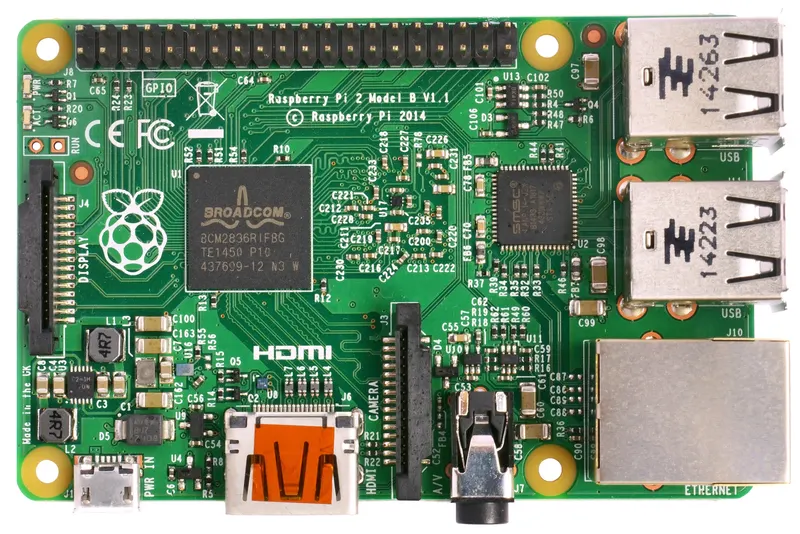
.jpg)
- CPU
- 4 × Cortex-A7 (rev 1.1); 4 × Cortex-A53 (rev 1.2 and later)
- Clock
- 900 MHz
- RAM
- 1 GB
- Storage
- microSD card
- I/O voltage
- 3.3 V
- Released
- February 2015
- Status
- In production
Draft entry: these specs were compiled from the linked sources and are waiting for a second check. Spotted a mistake? Use the form at the end of the page.
Specifications
- Chip / SoC
- Broadcom BCM2836 (rev 1.1), BCM2837 (rev 1.2), BCM2837B0 (rev 1.3)[2]
- CPU
- 4 × Cortex-A7 (rev 1.1); 4 × Cortex-A53 (rev 1.2 and later)[3]
- Clock
- 900 MHz[7]
- RAM
- 1 GB[2]
- Storage
- microSD card[2]
- GPIO
- 40-pin header[2]
- I/O voltage
- 3.3 V[4]
- Input voltage
- 5 V via micro-USB[2]
- Ethernet
- 100 Mb/s[2]
- USB
- 4 × USB 2.0[2]
- Video
- HDMI; composite on the 3.5 mm AV jack; DSI display connector[2]
- Expansion
- CSI camera connector[2]
- Launch price
- US$35[7]
Can I still use it?
- Raspberry Pi OS
- Supported[9]32-bit image on revision 1.1; revision 1.2 and later can also run the 64-bit image.
As published by each project, checked weekly. A platform not listed has no published information here, which is not the same as no support.
Datasheets and documents
Pinout
- Power
- Ground
- GPIO
- Special
- Not connected
Pin table (40 pins)
| Pin | Label | Kind | Functions |
|---|---|---|---|
| 1 | 3V3 | Power | |
| 2 | 5V | Power | |
| 3 | GPIO2 | GPIO | I2C1 SDA |
| 4 | 5V | Power | |
| 5 | GPIO3 | GPIO | I2C1 SCL |
| 6 | GND | Ground | |
| 7 | GPIO4 | GPIO | GPCLK0 |
| 8 | GPIO14 | GPIO | UART TXD |
| 9 | GND | Ground | |
| 10 | GPIO15 | GPIO | UART RXD |
| 11 | GPIO17 | GPIO | |
| 12 | GPIO18 | GPIO | PCM CLK, PWM0 |
| 13 | GPIO27 | GPIO | |
| 14 | GND | Ground | |
| 15 | GPIO22 | GPIO | |
| 16 | GPIO23 | GPIO | |
| 17 | 3V3 | Power | |
| 18 | GPIO24 | GPIO | |
| 19 | GPIO10 | GPIO | SPI0 MOSI |
| 20 | GND | Ground | |
| 21 | GPIO9 | GPIO | SPI0 MISO |
| 22 | GPIO25 | GPIO | |
| 23 | GPIO11 | GPIO | SPI0 SCLK |
| 24 | GPIO8 | GPIO | SPI0 CE0 |
| 25 | GND | Ground | |
| 26 | GPIO7 | GPIO | SPI0 CE1 |
| 27 | ID_SD | Special | GPIO0, HAT EEPROM I2C SDA |
| 28 | ID_SC | Special | GPIO1, HAT EEPROM I2C SCL |
| 29 | GPIO5 | GPIO | |
| 30 | GND | Ground | |
| 31 | GPIO6 | GPIO | |
| 32 | GPIO12 | GPIO | PWM0 |
| 33 | GPIO13 | GPIO | PWM1 |
| 34 | GND | Ground | |
| 35 | GPIO19 | GPIO | PCM FS, SPI1 MISO |
| 36 | GPIO16 | GPIO | SPI1 CE2 |
| 37 | GPIO26 | GPIO | |
| 38 | GPIO20 | GPIO | PCM DIN, SPI1 MOSI |
| 39 | GND | Ground | |
| 40 | GPIO21 | GPIO | PCM DOUT, SPI1 SCLK |
Gotchas
- Check your revision. Revision 1.1 is 32-bit only (Cortex-A7); revisions 1.2 and 1.3 have 64-bit Cortex-A53 cores. Revisions 1.1 and 1.2 reached end of life in October 2025.[2]
- 3.3 V only. The GPIO pins are 3.3 V. Do not connect 5 V signals or components to them.[4]
- Little current per pin. Each GPIO pin can supply up to about 16 mA and all pins together about 50 mA; drive motors and other loads through a transistor or driver board.[5]
What changed
Since the Raspberry Pi 1 Model B+
| Spec | Raspberry Pi 1 Model B+ | Raspberry Pi 2 Model B |
|---|---|---|
| Chip / SoC | Broadcom BCM2835 | Broadcom BCM2836 (rev 1.1), BCM2837 (rev 1.2), BCM2837B0 (rev 1.3) |
| CPU | Arm1176JZF-S (ARMv6), single core | 4 × Cortex-A7 (rev 1.1); 4 × Cortex-A53 (rev 1.2 and later) |
| Clock | 700 MHz | 900 MHz |
| RAM | 512 MB | 1 GB |
Next came the Raspberry Pi 3 Model B
| Spec | Raspberry Pi 2 Model B | Raspberry Pi 3 Model B |
|---|---|---|
| Chip / SoC | Broadcom BCM2836 (rev 1.1), BCM2837 (rev 1.2), BCM2837B0 (rev 1.3) | Broadcom BCM2837 (BCM2837B0 in boards built from January 2019; board revision unchanged at 1.2) |
| CPU | 4 × Cortex-A7 (rev 1.1); 4 × Cortex-A53 (rev 1.2 and later) | 4 × Cortex-A53 (ARMv8, 64-bit) |
| Clock | 900 MHz | 1.2 GHz |
| Wireless | — | 2.4 GHz 802.11n Wi-Fi; Bluetooth 4.1 and BLE |
Power and battery
Revisions
History and use today
History
Launched in February 2015 at the same $35, the Pi 2 replaced the single ARMv6 core with four Cortex-A7s and doubled the RAM to 1 GB, which made a usable desktop possible for the first time.[7]
Still useful for
A capable headless server for Pi-hole, a print server or home automation. Raspberry Pi still produces revision 1.3 for industrial customers.
Sources
- Raspberry Pi hardware, Raspberry Pi documentation
- Raspberry Pi hardware introduction (documentation source)
- Processors, Raspberry Pi documentation
- GPIO and the 40-pin header, Raspberry Pi documentation (source)
- Power supplies, Raspberry Pi documentation (source)
- Raspberry Pi OS, Raspberry Pi documentation
- Raspberry Pi 2 on sale now at $35, Raspberry Pi news
- Raspberry Pi, Wikipedia
- Raspberry Pi OS downloads, Raspberry Pi
Spotted a mistake?
Every report is read by a person and checked against a source before anything changes. Please link one if you have it.